Oneworld
This guide explains how oneworld works as a global airline alliance, which airlines are involved, what benefits flow across members and when it makes sense to think in terms of alliances rather than just individual airlines.
What oneworld is
oneworld is a global airline alliance that connects multiple national and regional airlines into a coordinated network. The goal is to make it easier for travellers to fly long distances on more than one carrier while enjoying a degree of consistency in benefits, baggage rules and through ticketing.
From a loyalty perspective, alliances allow status earned with one member airline to be recognised by others, so travellers can still access lounges, priority lanes and other perks even when they are not flying their primary carrier.
Member airlines and network shape
Member airlines typically include a mix of large, globally recognised carriers and smaller regional airlines. Together they create a network that reaches many destinations around the world. The exact list of members and hubs changes over time as airlines join, leave or restructure, but the principle is that all members work together more closely than simple interline agreements.
For travellers, this means more options when planning complex itineraries and often smoother handling if a delay causes a missed connection. The alliance framework helps with rebooking and customer service when multiple airlines are involved in a single journey.
Alliance wide benefits for frequent flyers
The main benefit of alliances for frequent flyers is status recognition. If you hold mid or top tier status with one member airline, you will usually receive equivalent alliance status, which then brings lounge access, priority check in, priority boarding and extra baggage across many carriers in the alliance, not just your home airline.
This reduces the need to chase status separately with multiple airlines and allows you to centralise your flying, at least within the alliance, into a single chosen frequent flyer program where you earn miles and progress up the tiers.
How this alliance compares to others
Each alliance has different member airlines, hub structures and strengths. Some are stronger across the Atlantic, others in Asia or within Europe. When you choose a home program, you are also in a way choosing which alliance you will naturally lean toward, because your status and redemptions will be easiest to use within that family of airlines.
Comparisons between alliances are therefore less about individual flights and more about whether the member airlines and hubs line up with the routes you actually fly. If they do, an alliance can be a powerful tool. If they do not, you may be better off focusing on non alliance carriers or building a portfolio of programs instead.
Who should care most about alliances
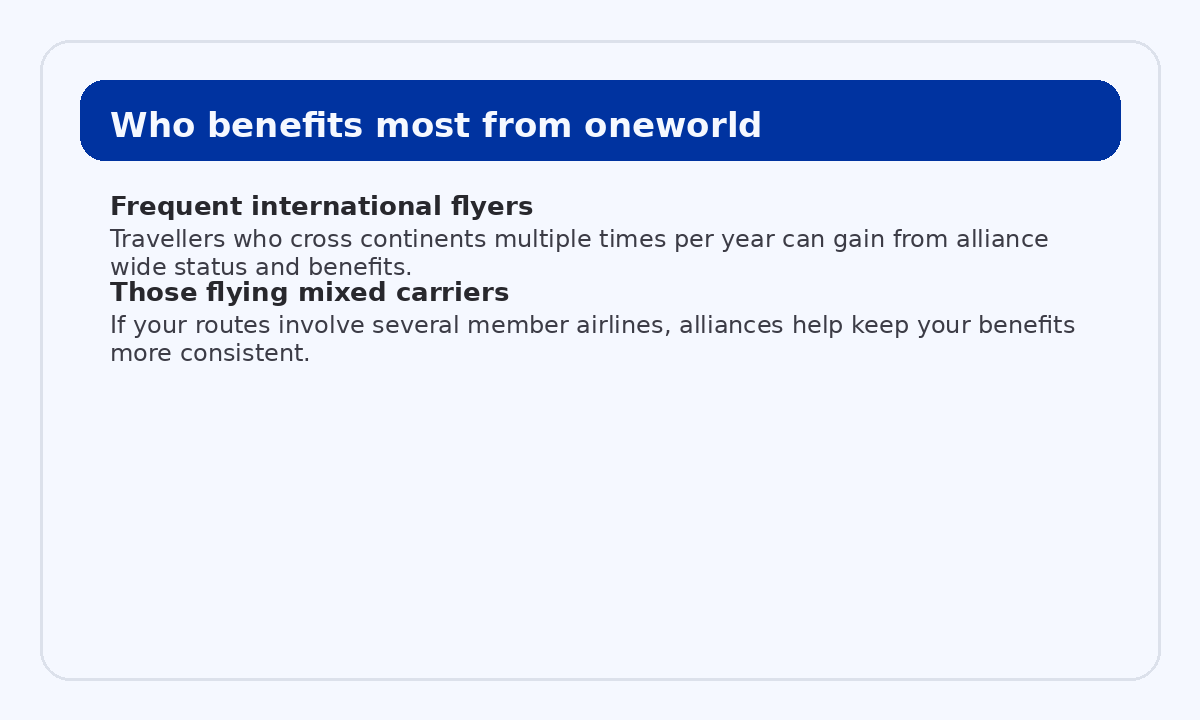
Alliances matter most to travellers who frequently take connecting flights across continents and who care about having a consistent experience. If your flying is mostly point to point on low cost carriers or single airlines, alliances may not change much for you day to day.
For those who do qualify for mid or top tier status with at least one legacy carrier, however, alliances are a big part of the story, because they extend your treatment and redeeming options well beyond your primary airline.