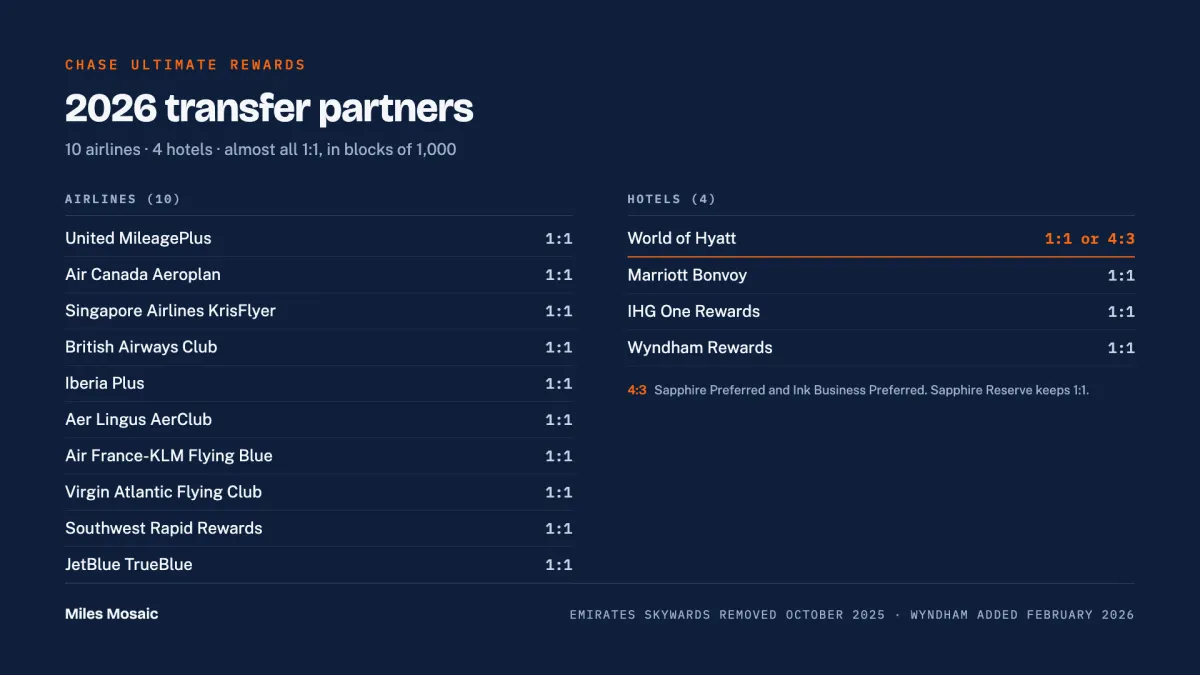
Chase Ultimate Rewards Transfer Partners (2026): The Full List, Ratios and the Hyatt Catch
Chase Ultimate Rewards has 14 transfer partners in 2026: 10 airlines, 4 hotels, every ratio and transfer time, and the World of Hyatt 4:3 s…
Read article →Independent Miles Mosaic guide. No programme partnerships, no account linking, no scraped balances. Sources cited below; corrections welcomed.

Almost everyone who has booked a reward flight with credit card points has watched a seat vanish during a transfer. You see the saver award, click through to your bank's transfer page, confirm, log in. The seat is gone. Now you hold airline miles in a programme you don't use, with no way to move them back.
That single failure mode is the most common reason credit card point users come away from award booking feeling burned. It is also entirely avoidable, once you understand what is actually happening under the hood and book in the right order.
This is a practical walk-through: how transferable points work, where the timing risks really sit, and how to book reward flights without losing the seat mid-transfer.
The first piece of clarity worth having is that "points" is not one thing.
These are miles you earn or hold in a specific airline's frequent flyer programme: KrisFlyer miles, Avios, Flying Blue Miles, AAdvantage miles. You can spend them only inside that programme's redemption universe, which may include alliance and non-alliance partners depending on the airline.
Marriott Bonvoy, Hilton Honors, World of Hyatt, IHG One Rewards. These are most useful for hotel redemptions, but some (Bonvoy in particular) can transfer out to airline mile programmes at variable ratios.
Chase Ultimate Rewards, American Express Membership Rewards, Citi ThankYou Points, Capital One Miles, Bilt Points, and Wells Fargo Rewards. In Singapore, equivalents include Amex Singapore Membership Rewards, DBS Points, Citi Singapore ThankYou Points, and UOB Rewards. These are the flexible currencies. They sit at the bank until you point them at an airline or hotel partner.
This third bucket is where most of the upside in modern points strategy lives. Flexible bank points hedge devaluation risk in any one airline programme, can be redirected as travel plans change, and unlock award sweet spots that would otherwise require qualifying for a specific co-brand card.
The defining feature of bank-to-airline transfers is that they are irreversible. Once your Membership Rewards points become Singapore Airlines KrisFlyer miles, they are KrisFlyer miles. There is no programme-supported route back. The same applies to Chase Ultimate Rewards → Hyatt, Citi ThankYou Points → Avianca LifeMiles, Capital One → Flying Blue, and so on.
That single fact is the source of every horror story. If you transfer before you have a confirmed seat, and the seat then disappears, your only options are to find a different redemption inside the airline programme you just transferred to, hold the miles indefinitely, or write the points off.
The rule is therefore very simple: seat first, transfer second.
Saver award seats are scarce by design. The airline only loads a small number of them, and they can disappear within minutes once a popular route opens up. The mismatch between "transfer takes hours" and "seat lives for minutes" is where most failed redemptions live.
Transfer times are not guarantees. Banks and loyalty programmes may delay transfers for account verification, first-time partner links, fraud review, weekends, public holidays, or system batching. Treat any non-instant transfer as a seat-risk event. The figures below are commonly reported timings as of mid-2026 and vary by country, card product, partner, account history and fraud review; always check the current quote on your bank's transfer page before moving points against a scarce seat.
| Bank programme | Commonly reported transfer timing (verify before booking) | Notable slow exceptions |
|---|---|---|
| Chase Ultimate Rewards | Instant to a few hours for most partners | Singapore KrisFlyer commonly cited around 48 hours and sometimes up to 7 days; Marriott Bonvoy commonly up to 48 hours |
| American Express Membership Rewards (US) | Often instant for Delta, Hilton; longer for most other partners | ANA Mileage Club typically multiple days; some partners delay further |
| Citi ThankYou Points (US) | Most partners same-day to 24 hours | EVA Air around 72 hours; Thai Royal Orchid Plus 7–14 days |
| Capital One Miles | Instant or near-instant for many partners (Flying Blue, BA, Emirates) | Cathay Pacific Asia Miles can run several days; Turkish Miles&Smiles is throttled |
| DBS Points (SG) | 1–2 working days for most airline partners | First-time transfers can quote up to 10 working days for security review |
| UOB Rewards (SG) | 1–2 working days for most airline partners | Longer on first transfer to a new programme pair |
| Citi Singapore ThankYou Points | Commonly reported as a few working days for airline transfers, but verify the current estimate inside Citi Mobile before any redemption-critical transfer | Partner-by-partner timings differ |
| Amex Singapore Membership Rewards | Varies significantly by partner. Some airline transfers may quote up to 10 working days, and hotel partners can be much slower, with Hilton and Marriott showing multi-week estimates on Amex Singapore's own transfer pages | Co-brand KrisFlyer cards batch monthly, points credit at end of statement |
The practical heuristic underneath these numbers: instant transfers are usable against scarce seats; one-to-three-day transfers require an award hold or a strong Plan B; anything longer is a gamble unless your seat can be held in advance.
Two patterns matter more than the individual numbers. First, the same bank programme can be instant to one partner and slow to another, so the transfer time you care about is the one for the specific partner you are about to use, not "Chase transfers are fast". Second, the first transfer between any new bank-to-airline pair is almost always slower because both sides run anti-fraud checks. If you have never moved Citi points to KrisFlyer before, do not assume tomorrow's saver seat is safe.
"Find an award seat first" sounds obvious until you try. The single largest improvement most people can make is searching the partner award space, not just the home programme.
If you have Chase Ultimate Rewards points, you can move them to United, Air Canada Aeroplan, Air France-KLM Flying Blue, Virgin Atlantic Flying Club, British Airways Avios, Singapore KrisFlyer, Iberia, Emirates, JetBlue, and several others. Each of those programmes searches partner award availability through its own engine, and they show different inventory.
For long-haul partner space:
The objective is to find a saver award seat with confirmed availability in the airline's own engine, sometimes including pulling up the exact flight numbers and date that you can ticket. Some programmes show "saver space" but require a call to confirm. Confirm before you transfer.
Award holds are one of the safest ways to avoid losing a seat during a points transfer, but they are less common than many travellers assume, and rarely as universal as blog posts make them sound. The realistic picture in 2026:
If a hold is available on your specific itinerary, place it first and then transfer the points. The seat is locked while the transfer runs, which is the lowest-risk pattern for any longer-than-instant transfer. Treat every hold as programme-specific and itinerary-specific: confirm the hold, write down the expiry time, then transfer. Do not assume a hold exists because a programme has offered one before.
For programmes that do not offer holds, including Singapore KrisFlyer for most fare types and Delta SkyMiles, the options narrow to: redeem from an existing miles balance, use a transferable currency that posts within minutes, or accept the timing risk and have a Plan B ready.
A reward flight is "free" only in the sense that the base fare is paid in miles. Taxes, government fees, and airline-imposed fuel or carrier surcharges still settle in cash. Some programmes pass through large surcharges (British Airways Avios redemptions on BA-operated long-haul flights are the most notorious example); others pass through almost nothing (United and American Airlines redemptions are typically low-fee). The total cash co-pay matters as much as the mile cost when you compare options.
If you are using bank points, you usually have a choice between two or more programmes that price the same itinerary differently. KrisFlyer might price a Singapore to London flight at one mileage total with one set of surcharges; Air Canada Aeroplan might price the same physical seat at a different mileage total with a different set of surcharges. Total cost, miles plus taxes, is the right number to compare.
Transferring points is not always the right move. It is the wrong move when:
The discipline of using flexible points well is doing nothing until the right opportunity arrives, then moving quickly and precisely when it does.
The reason transferable points get wasted is rarely lack of strategy. It is lack of visibility. People forget how many points they have, how much status they already hold in a programme that would otherwise be a logical transfer target, and when programmes are running transfer bonuses. Miles Mosaic consolidates airline mile, hotel point, and bank-points programme balances in one dashboard, so the "what would this transfer actually look like for me" question takes seconds rather than half an hour.
Specific articles that pair well with this one:
The pattern that turns credit card points into reliably-booked reward flights is not exotic. Search first, transfer second. Verify the seat with the airline whose currency you will use. Match your name across accounts. Use award holds where they exist. Know the transfer time for your specific bank-to-airline pair. Transfer only what you need. Then ticket immediately.
Do that consistently and the points programmes start to feel less like a slot machine and more like a tool. Skip any of those steps and you eventually find yourself sitting on a pile of airline miles you did not really want, which is exactly the outcome the transferable currency was meant to prevent.
See your requalification forecast in under a minute. No account, and never a loyalty password.
Forecast my status, free →Share
Last reviewed: · How we research and update
Chase Ultimate Rewards has 14 transfer partners in 2026: 10 airlines, 4 hotels, every ratio and transfer time, and the World of Hyatt 4:3 s…
Read article →A 2026 guide to award availability and dynamic pricing: how airlines actually release award seats, and how to search for them more intellig…
Read article →A 2026 guide to pooling and transfer strategy: household accounts, family-sharing rules, timing, and how to avoid locking points in the wro…
Read article →